



Example Yunnan trips
These are simply suggestions for the kind of holiday you might have. Yours will be tailored, altered, and refined until it matches you completely.
Indigo Threads: A Hands-On Day in Dali's Tie-Dye Village
In northern Dali, Zhoucheng Village—China’s largest Bai settlement—keeps alive a tradition that began in Central China more than a thousand years ago, later reshaped here by botanical dyes from the Cangshan foothills. Bai tie-dye is still practiced by more than 200 households. With a local artisan beside you, you don’t just admire the cloth—you stitch your story into it.
In a quiet Bai courtyard, white cotton meets plant-fermented indigo — and a thousand years of pattern, memory, and patience flow through your hands.
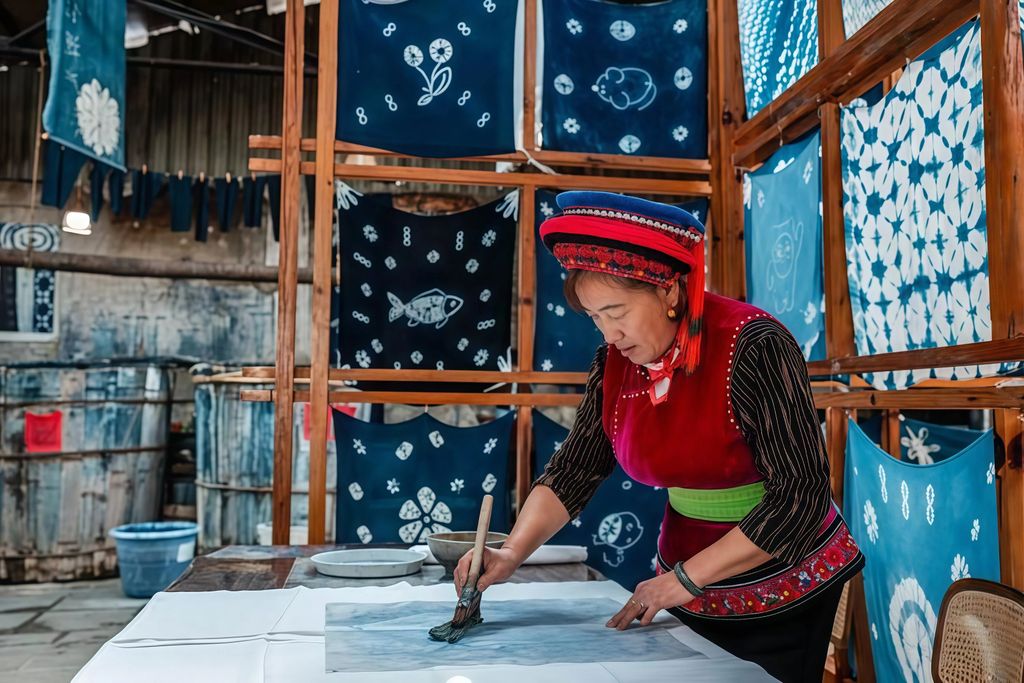
**Tie Your Own Pattern with a Bai Artisan
Using needle, thread, bamboo, and string, the artisan shows you how to stitch, wrap, clamp, and pinch sections of white cotton so they resist the dye. With over 1,000 traditional patterns to choose from, every motif carries meaning — butterflies for love and vitality, plum blossoms for nobility and purity, bees for diligence, and scenes of Cangshan and Erhai for the beloved local landscape. Every fold is a small decision, and every piece will be one of a kind.

Dip into the Living Indigo Vat
The dye is tǔdiàn (earth indigo)—a fermented brew of banlangen (indigo root) ( Isatis tinctoria ) and other Cangshan plants, with no chemicals added. The blue comes entirely from these mountain botanicals, while the white is simply the cotton’s natural color, preserved by each careful knot. You dip your tied bundle into the vat, lift it out dripping, and let it oxidize—watching it shift from yellow-green to a deep, luminous indigo. Traditional pieces are dipped a dozen times or more, each round deepening the shade until the color settles into the cotton.
When you finally untie the threads, the cloth surprises everyone — even the master beside you. Where you pinched, white blooms appear; where you wrapped, soft halos of blue feather outward. It is a piece no one else has ever made, and no one ever will.
Plan for about 2–3 hours, from tying to the final reveal. No experience is needed—the Bai artisan guides you step by step, and you can choose a pattern that matches your comfort level, from a simple butterfly motif to a more intricate Cangshan–Erhai scene. It’s suitable for first-timers, couples, and families with children (around 6+).
Yes, it’s safe. The vat is fermented from banlangen (Isatis tinctoria) and other Cangshan plants, with no chemical additives—the same plant traditionally valued in Chinese medicine for its skin-friendly properties. Your fingertips may turn temporarily blue during dipping (it typically washes off within a day or two), so we recommend wearing dark, casual clothes or rolling up your sleeves. Aprons and gloves are available on request.
Absolutely—that’s the best part. After the final dip and oxidation, the artisan helps you rinse, untie, and air-dry your piece, and you’ll leave with your one-of-a-kind cotton scarf or square that same afternoon. For the first 2–3 washes at home, hand-wash separately in cold water with a mild detergent to preserve the depth of the indigo.